Luxembourg company and director search
Search Luxembourg companies and their directors, and read how the Registre de commerce et des sociétés works: what it records, what is public and which documents you can get.
424,968 companies and 438,670 directors of Luxembourg, from the records of the Registre de commerce et des sociétés. Newest filing received: 13 November 2026.
Searching by name is free. Documents are paid one at a time; no subscription is necessary.
Luxembourg company documents
Search the company, or open a document below and choose the company there. Each document page says what it contains and gives the price and the delivery time before you pay, with pages of a real example where we have one.
- Electronic Certified Copy of a Luxembourg Company Filing
Certified electronic PDF copy of a Luxembourg company filing obtained from the RCS via LBR.
Electronic PDF by e-mail, up to 2 business days€49View details - Luxembourg Certified Copies of Company Documents
Certified electronic copies of all available Luxembourg company documents and annual accounts.
€8 per filed document, minimum €119. The exact amount shows when you choose the company. Electronic files (ZIP with PDF documents), up to 2 business daysFrom €119View details
Dato Capital is a private company, not the Registre de commerce et des sociétés. A certificate or a copy is a document of the register that we obtain for you; a report is compiled by Dato Capital from the register's records.
Luxembourg company information at a glance
Each company in the Registre de commerce et des sociétés (Trade and Companies Register) receives a unique registration number, and commercial companies are in section B (company numbers).234 The register collects, keeps and makes available to the public the information the law requires.1 Its public search works by name or by registration number.3334
- Public: the name, form, registered office, object, capital and date of incorporation; the directors, managers, signing powers and auditors; the members of a private limited company (SARL) and their shares; the articles and every amendment; the annual accounts of public and private limited companies, European companies, partnerships limited by shares and cooperatives (not those of pension savings companies with variable capital), abridged for small companies, and of general or limited partnerships whose unlimited partners are all companies of the kinds described in article 77; bankruptcy and liquidation decisions (what is public).1616
- Not public: the later shareholders of a public limited company (SA), simplified joint-stock company (SAS) or partnership limited by shares (SCA), whose share register is kept by the company and open to its shareholders (the published deed of incorporation names the persons who signed it); the beneficial owners, open since 1 February 2025 to the authorities, professionals doing due diligence, self-regulatory bodies, authorised public bodies and persons with a legitimate interest (shareholders, beneficial owners).61011
- Changes: a change, such as of the office, the officers or the capital, is filed electronically within one month; deeds that must be published appear on the electronic compendium within fifteen days (filings).1
- Documents: a certified extract of the company's public data; a certified copy of a document in the company's public file, such as the articles or annual accounts that are open to the public; an insolvency register certificate; a beneficial owners extract for persons who have access; an apostille, also in electronic form since 7 May 2026 (documents and certificates).1112230323334
- Status: bankruptcy judgments are entered in the register; since the Law of 23 January 2025, the register can strike off a file that stays wrong or incomplete, and this does not dissolve the company; Luxembourg Business Registers announced that it would begin applying these measures gradually from 21 September 2026 (company status).11228
The Registre de commerce et des sociétés
Luxembourg companies are registered in the Registre de commerce et des sociétés. It exists under article 1 of the Law of 19 December 2002 on the trade and companies register and on the accounting and annual accounts of undertakings.1 It collects, keeps and makes available to the public the information the law requires.1
Article 1 of the 2002 law lists who must register, from sole traders and commercial companies to associations, foundations, funds and branches.1 The information registered must be adequate, accurate and current.1
The register works under the authority of the Minister of Justice. Its manager is an economic interest grouping of the State, the Chamber of Commerce and the Chamber of Trades (article 2).1 That grouping is called Luxembourg Business Registers (article 1 of the grand-ducal regulation of 23 January 2003, as amended on 13 March 2025).25
How current it is
A registration or a change must be filed within one month of the event (article 15 of the 2002 law).1 The register must enter it within three working days (article 21).1 It makes a summary legal check and can refuse a filing, but it is not responsible for the content filed.1
Deeds that must be published are filed electronically within one month (article 19-1).1 They appear on the Recueil électronique des sociétés et associations (Electronic Compendium of Companies and Associations) within fifteen days (article 19-2).1 A deed can be relied on against third parties only from its publication there, or earlier against third parties whom the company proves knew of it (article 19-3).1 For transactions before the sixteenth day after publication, it cannot be relied on against third parties who prove that they could not have known of it.1
Languages
Filed deeds are in French, German or Luxembourgish, and a voluntary translation into any official language of the European Union may be added (article 22-2).1 Annual accounts may be in German or English instead of French (article 75).1
History
The 2002 law repealed the act of 23 December 1909 that first created the register (article 95).1 The regulation of 23 January 2003 that implements the 2002 law came into force on 1 February 2003 (article 41), and the files kept under the 1909 act passed to the register's manager on that date (article 39).2
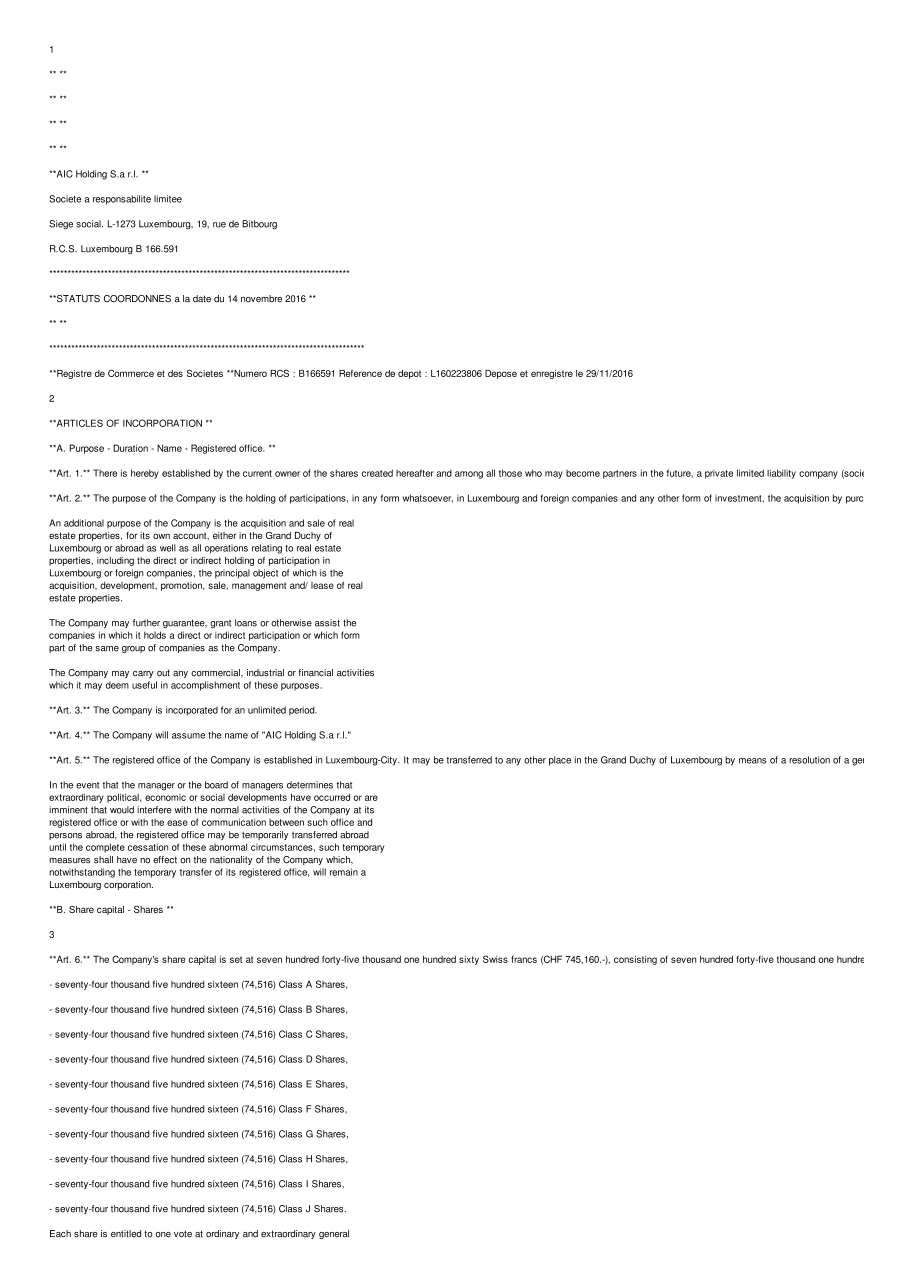
Types of company in Luxembourg
Article 100-2 of the Law of 10 August 1915 on commercial companies lists, in seven points, the commercial companies with legal personality: the SNC, the SCS, the SA and the SAS, the SCA, the SARL and the SARL-S, the cooperative and the SE.6
Scroll sideways to see all columns.
| Form | Liability and capital | Article |
|---|---|---|
| Société anonyme (public limited company), SA | One shareholder or more. Capital at least EUR 30,000, each share paid up to at least one quarter. | 420-16 |
| Société européenne (European company), SE | Capital at least EUR 120,000. | 420-16 |
| Société par actions simplifiée (simplified joint-stock company), SAS | Shareholders liable up to their contribution. No public issue of shares. Represented by a president. | 500-1, 500-2, 500-46 |
| Société à responsabilité limitée (private limited company), SARL | Capital at least EUR 12,000. One to 100 members. | 710-1, 710-4, 710-56 |
| Société à responsabilité limitée simplifiée (simplified private limited company), SARL-S | Capital EUR 1 to EUR 12,000. Members and managers must be natural persons; a person may be a member of only one SARL-S at a time, unless the shares come to them on a death. | 720-2, 720-4, 720-66 |
| Société en commandite par actions (partnership limited by shares), SCA | At least one shareholder with unlimited liability; the others liable up to their contribution. | 600-16 |
| Société en nom collectif (general partnership), SNC | All partners jointly and without limit liable. | 200-16 |
| Société en commandite simple (limited partnership), SCS | General partners with unlimited liability, limited partners liable up to their contribution. | 310-16 |
| Société en commandite spéciale (special limited partnership), SCSp | As the SCS, but without legal personality separate from its partners. | 320-16 |
| Société coopérative (cooperative company) | Variable members and contributions; shares not transferable to third parties. | 811-16 |
The SA, the SCA and the SARL are formed by notarial deed (article 100-4).6 The SNC, SCS, SCSp, cooperative, civil company and SARL-S may also be formed by private deed.6 The capital of an SARL must be fully subscribed. Since the Law of 18 May 2026, published in the Journal officiel on 29 May 2026 and in force since 2 June 2026, its shares may be paid up within twelve months of incorporation, unless the articles set a shorter period (article 710-6).835 Any amount above the minimum capital, any share premium and shares issued for contributions in kind are paid in full at incorporation.8 In an SARL-S, the deferral applies to all the capital subscribed at incorporation, when it is contributed in cash (article 720-4).8 The SARL-S dates from a law of 23 July 2016.6
Civil companies under the Civil Code also have legal personality (article 100-3).6 Non-profit associations and foundations are governed by the Law of 7 August 2023, which replaced the law of 21 April 1928 (article 76).19 A foundation needs approval by grand-ducal decree and initial assets of at least EUR 100,000 (article 40).19
Company numbers
Each person or entity in the register receives a unique registration number (article 11 of the regulation of 23 January 2003).334 Each file sits in a section named by a letter. Section B holds commercial companies. Section A holds sole traders, E civil companies, F non-profit associations and G foundations.2 Later sections include K for common investment funds (2016), L for reserved alternative investment funds, M for mutual societies (2020), O for securitisation funds (2022) and N for branches (2023).323242534 The public search on the register's website works by name or by registration number (article 22(1), as replaced on 17 February 2025).33 On a request for access to a large volume of its information, which must give reasons and state the purposes of reuse, the register may make all or part of its public data and public filed documents available through its electronic platform (article 22(2)).33
What is public
The table describes the information normally obtainable from the Registre de commerce et des sociétés and the electronic compendium. The legal basis gives the law, its article and its year; the year of a law does not show when an item first became public.
Scroll sideways to see all columns.
| Item | Public | Legal basis |
|---|---|---|
| Name, form, registered office, object, capital, date of incorporation | Yes | Law of 19 December 2002, art. 1, 61 |
| Directors, managers, signing powers, auditors | Yes; the sex of a person is collected optionally, for statistics only, and is not shown | Law of 19 December 2002, art. 6, 11ter1 |
| Members of an SARL or SARL-S and their shares | Yes | Law of 19 December 2002, art. 61 |
| Shareholders of an SA, SAS or SCA | The persons who signed the deed of incorporation, in the published deed; later shareholders are not filed with the register: the share register is kept at the registered office and open to the shareholders | Law of 10 August 1915, art. 100-10, 420-15, 430-3, 500-1, 600-26 |
| Holders of bearer shares | No public access: the register of bearer shares is kept by a depositary in Luxembourg, and each holder may see only their own entries; the depositary's appointment is registered | Law of 10 August 1915, art. 430-66; Law of 19 December 2002, art. 131; Law of 28 July 20149 |
| Articles and every amendment | Yes | Law of 10 August 1915, art. 100-10, 100-136; Law of 27 May 201616 |
| Annual accounts of SA, SE, SCA, SARL, cooperatives, and of SNC or SCS whose unlimited partners are all companies of the kinds described in article 77 | Yes, except those of pension savings companies with variable capital; small SA, SE, SCA, SARL and cooperatives may publish abridged accounts; some such partnerships with only foreign unlimited partners may keep their accounts at the registered office instead | Law of 19 December 2002, art. 77, 791 |
| Annual accounts of other companies that file them, such as other general and limited partnerships | No public access: filed with the register and passed to the Central Balance Sheet Office; a special limited partnership files financial information for statistics only | Law of 19 December 2002, art. 75, 76, 771 |
| Beneficial owners | No public access; access for national authorities, professionals doing due diligence, self-regulatory bodies, public bodies authorised by law and persons with a legitimate interest; the address and identification number for national authorities only | Law of 13 January 2019, art. 11, 12, as replaced by the Law of 23 January 20251112; the 2019 text opened part of it to any person, art. 1210 |
| Bankruptcy and liquidation decisions | Yes | Law of 19 December 2002, art. 13, 23-11 |
The register keeps a file for each company with the documents filed (article 19-4 of the 2002 law). The files are public and can be consulted electronically, on site, on the register's website or through its electronic platform (article 20(1) of the regulation of 23 January 2003, as amended on 17 February 2025).133 A copy of the annual accounts of the companies whose accounts are open to the public goes into the file (article 77); the accounts of other companies go to the Central Balance Sheet Office (article 76), and beneficial owners are recorded in a separate register with restricted access (beneficial owners).111 A full or partial copy of a document in the file can be requested on paper or through the register's website (article 20bis of the regulation), for the administrative fee, certified as a true copy unless the applicant waives it (article 19-4).134
Directors
A company's registration names every person authorised to manage, administer and sign for it (article 6 of the 2002 law).1 It records their function, signing rules, date of appointment, end of mandate and private or professional address.1 For a natural person the register collects the name, date and place of birth, nationalities, country of residence and national identification number (article 11ter).1
An SA has at least three directors. When it has a single shareholder, the board may be limited to one member until the next annual general meeting after it has more than one shareholder (article 441-2 of the 1915 law).6 A legal person may be appointed director, member of the management committee or general manager of an SA; it names a permanent representative, who is published too (article 441-3).6 The same applies to a legal person appointed president or director of an SAS (article 500-5).6 An SARL is run by one or more managers, members or not (article 710-14).6 The managers of an SARL-S must be natural persons (article 720-6).6 For a legal person, the register records only its Luxembourg registration number or, for one not registered in Luxembourg, its name, legal form, its registration number where its law provides one, and the name and country of its register (article 11ter of the 2002 law).1
Appointments and departures of directors, managers, daily managers, auditors and liquidators are filed and published (article 100-13).6 The time limit is one month (article 15 of the 2002 law), and a director who resigns may file the resignation personally (articles 13 and 14).1 Since the Law of 19 December 2025, the register refuses to register a person barred from managing a company by a Luxembourg court or a court of another EU member state (article 21).121
Beneficial owners
The Registre des bénéficiaires effectifs (Register of Beneficial Owners) was created by the Law of 13 January 2019 and is managed by Luxembourg Business Registers (articles 1 and 2).1011 Its regulation came into force on 1 March 2019.13 Entities had six months to file, and consultation could be requested after that period (article 27).10
A beneficial owner is the natural person who ultimately owns or controls the entity (article 1(7) of the anti-money laundering law of 12 November 2004).14 A holding of 25 percent of the shares plus one, or more than 25 percent of the capital, is a sign of ownership. If, after all possible means have been exhausted and provided there are no grounds for suspicion, no such person is identified, or if it is not certain that the persons identified are the beneficial owners, any natural person who holds the position of senior managing official is a beneficial owner (article 1(7)(a)(ii)).14
The register holds the owner's name, nationality, date and place of birth, country of residence, address, identification number, and the nature and extent of the interest (article 3 of the 2019 law).11 An entity files within one month of learning of a change (article 4).11
Who can see it today
From 2019, the name, birth details, nationality, residence and interest were open to any person (article 12, original text).10 On 22 November 2022, in two Luxembourg cases against Luxembourg Business Registers, the Court of Justice of the European Union declared invalid the EU rule that made this information accessible in all cases to any member of the public.15
The Law of 23 January 2025 rewrote access, in force since 1 February 2025.12 Article 11 now opens the register only to national authorities, professionals doing customer due diligence under the anti-money laundering law, self-regulatory bodies, public bodies authorised by law, and persons who show a legitimate interest in the fight against money laundering and terrorist financing.11 Legitimate interest includes professional journalists, non-profit organisations fighting money laundering, and anyone likely to do business with the entity.11
A request names each entity by number or name, with reasons and supporting documents (article 15bis).11 Luxembourg Business Registers decides on the advice of a consultative commission and sends an extract within three working days if it agrees. A refusal can be appealed to the administrative court within one month.11 Persons other than authorities do not see the address or the identification number (article 12).11 In exceptional cases, such as a risk of kidnapping or violence, or a minor owner, access can be restricted to the authorities, banks, financial institutions, bailiffs and notaries for up to three years, renewable (article 15).11
Financial statements
Every company keeps double-entry books and draws up annual accounts: balance sheet, profit and loss account and notes (articles 11 and 15 of the Commercial Code, article 26 of the 2002 law).1 The books follow a minimum standard chart of accounts (article 12 of the Commercial Code), set by the grand-ducal regulation of 12 September 2019.126 Sole traders and general or limited partnerships with a turnover up to EUR 100,000 may keep their books otherwise (article 13).1
Accounts are filed within one month of approval, and at the latest seven months after the year end, with the balance of the standard chart (article 75 of the 2002 law).1 Late filing costs a surcharge of EUR 50 to EUR 500 (annex J of the regulation of 23 January 2003, as amended on 13 March 2025).5 The accounts also go to the national statistics institute's Central Balance Sheet Office (article 76).1
The filing duty of article 75 applies to the undertakings of article 25. That article leaves out credit institutions, insurance and reinsurance companies, pension savings companies with variable capital, special limited partnerships, and sole traders and general or limited partnerships within the EUR 100,000 turnover limit.1 Public access covers the accounts of the SA, SE, SCA, SARL and cooperative, except pension savings companies with variable capital (article 77, point 1°).1 It also covers an SNC or SCS when all its partners with unlimited liability are companies of a form named in article 1(1)(a) of Directive 2013/34/EU, or companies from outside the European Union with a comparable legal form (point 2°); or when all of them are themselves organised in a form of point 1° or 2°, or of article 1(1)(a) or (b) of that Directive (point 3°).1 Such a partnership need not publish its accounts if they are available to the public at its registered office, with a copy on request, when its unlimited partners are all companies from other EU member states and none of them publishes the partnership's accounts with its own, or are all companies from outside the EU (article 79(1bis)).1 The accounts of other companies are filed but not open to the public; a special limited partnership files only financial information for statistics (articles 76 and 77).1 The management report may instead be kept at the registered office, where a copy is free on request (article 79).1
Exemptions by size
A small company stays within two of three limits: a balance sheet total of EUR 7,500,000, a net turnover of EUR 15,000,000 and 50 employees (article 35).1 It may publish an abridged balance sheet and notes, need not publish its profit and loss account, and has no statutory audit (articles 69 and 79).1 A medium company stays within EUR 25,000,000, EUR 50,000,000 and 250 employees, and may publish an abridged profit and loss account (article 47).1 A change of size counts after two consecutive years (article 36). Listed companies have no exemption.1 These limits were raised by the regulation of 25 October 2024, for financial years from 1 January 2023; the small limits had been EUR 4.4 million and EUR 8.8 million.4
Other companies are audited by approved statutory auditors (réviseurs d'entreprises agréés) appointed by the general meeting (article 69).1 An SA without that audit is supervised by statutory examiners (commissaires) appointed for at most six years (article 443-1 of the 1915 law).6
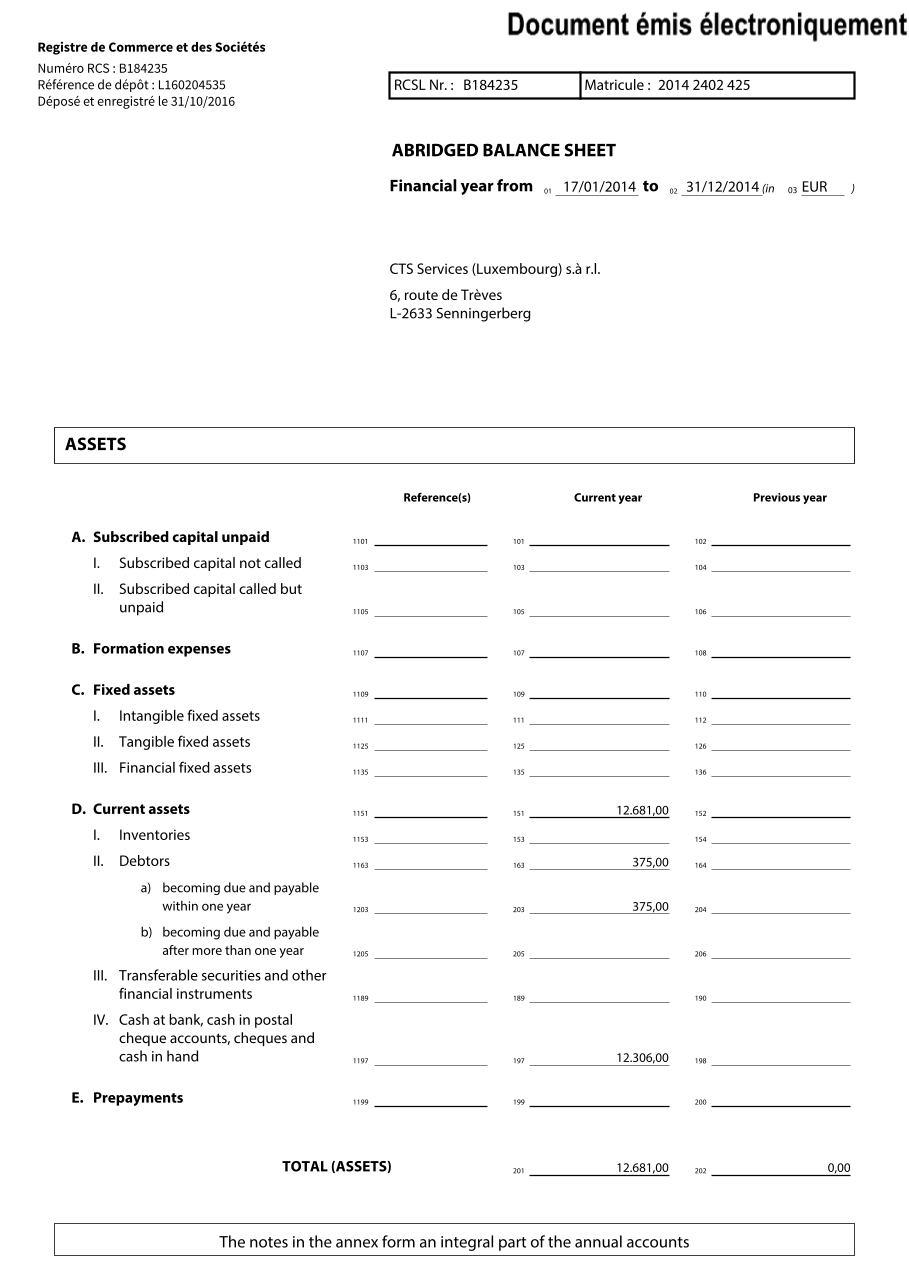
Filings
Filings are made electronically and signed with at least an advanced electronic signature (article 19-1 of the 2002 law), and the register publishes them through forms on its website (article 2quinquies of the regulation of 23 January 2003, inserted in 2016).13 Filings to be published appear on the electronic compendium within fifteen days (article 19-2 of the 2002 law).1
Scroll sideways to see all columns.
| Filing | What it reports | Time limit | Law |
|---|---|---|---|
| Registration (immatriculation) | A new company and its data | One month | 2002 law, art. 6, 151 |
| Change (modification) | Office, officers, auditors, capital, SARL members | One month | 2002 law, art. 151 |
| Deed of incorporation | Articles: in full for SA, SAS, SCA, SARL, cooperative; by extract for SNC, SCS, SCSp | One month | 2002 law, art. 19-1; 1915 law, art. 100-7, 100-1016 |
| Updated articles | Full articles after each amendment (SA, SCA, SARL) | One month | 1915 law, art. 100-13; 2002 law, art. 19-161 |
| Appointment or end of office | Directors, managers, auditors, liquidators, depositaries | One month | 1915 law, art. 100-13; 2002 law, art. 19-161 |
| Change of members | Members of an SARL or civil company | One month | 1915 law, art. 100-13; 2002 law, art. 19-161 |
| Annual accounts | Accounts, standard chart balance, management and audit reports | Seven months after year end at the latest | 2002 law, art. 75, 791 |
| Notice of general meeting (SA) | Date and agenda | Fifteen days before | 1915 law, art. 450-86 |
| Liquidation and its closure | Liquidators; where the books are kept | One month; at closure | 2002 law, art. 13; 1915 law, art. 1100-1516 |
| Termination of domiciliation | End of the agreement with a domiciliation agent | On termination | 1999 law, art. 320 |
| Beneficial owners | Declaration to the Register of Beneficial Owners | One month | 2019 law, art. 411 |
| Court decisions | Bankruptcy, judicial liquidation, bans; filed by court clerks | — | 2002 law, art. 13, 141 |
A company domiciled with a third party needs a written domiciliation agreement with a regulated professional in Luxembourg (article 1 of the Law of 31 May 1999).20
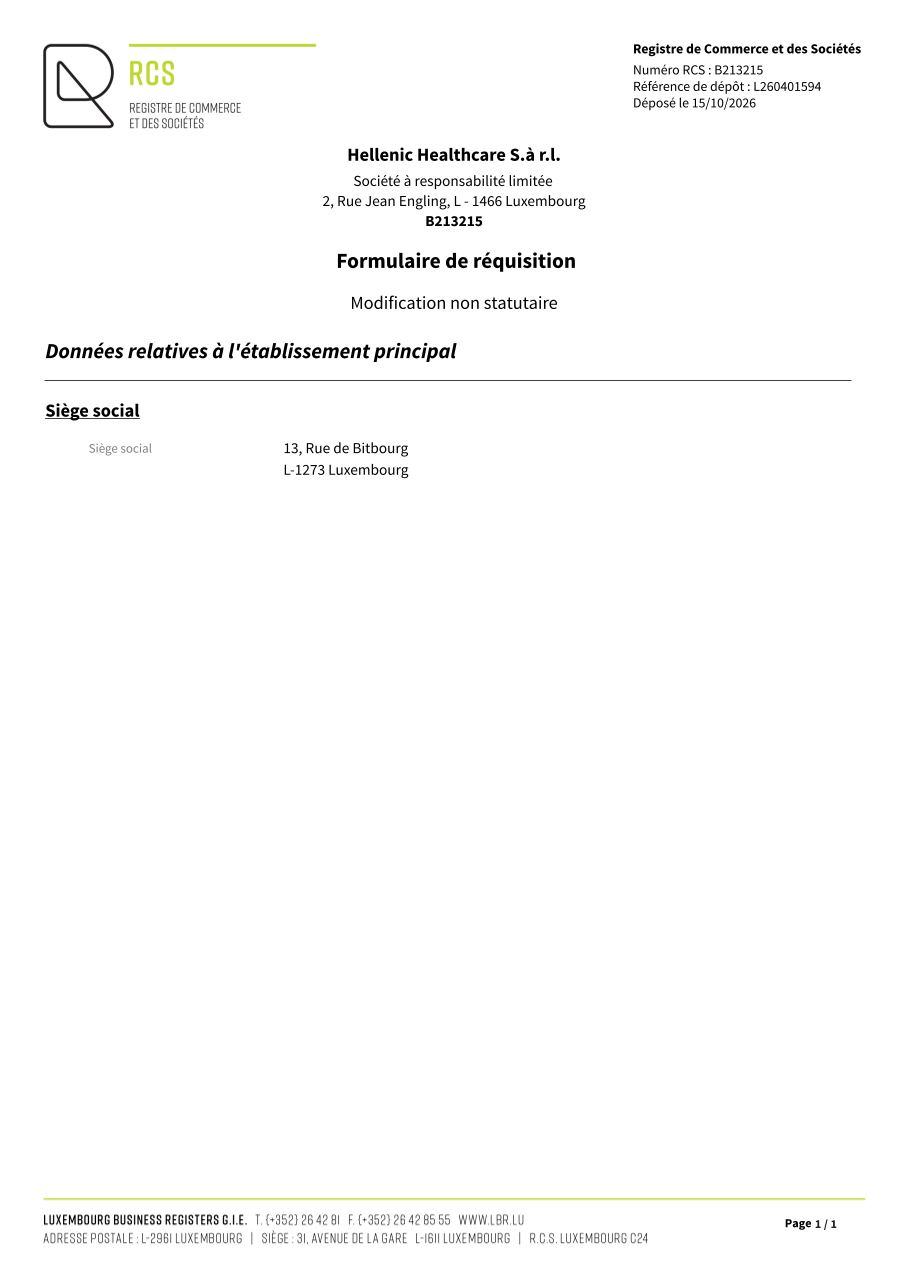
Documents and certificates
- Extract: a certified extract of the public data in the company's file, on watermarked paper with a handwritten signature or in electronic form with the register's electronic signature, as the applicant chooses (article 21 of the regulation of 23 January 2003, as replaced on 17 February 2025).33 It shows the registered data: name, form, office, object, capital, officers, auditors and, for an SARL, members.1
- Declaration that a fact is not registered, or that a person or entity is not registered (article 21).33
- Certified copies of documents in the company's public file: articles, deeds, and annual accounts that are open to the public (article 19-4 of the 2002 law, article 20bis of the regulation).134
- Insolvency register extract and certificate: the certificate states that no decision on bankruptcy, judicial dissolution or liquidation, administrative dissolution or a similar procedure is registered (regulation of 3 February 2023).22
- Certificate of failings, issued when a company ignores a request to update its file (article 19-6 of the 2002 law).1
- Beneficial owners extract, for persons who have access (article 14 of the 2019 law).11
Luxembourg has been a party to the Hague Convention of 5 October 1961 abolishing the requirement of legalisation for foreign public documents since 3 June 1979.31 An apostille certifies the authenticity of the signature, the capacity in which the signer acted and, where appropriate, the identity of the seal or stamp (articles 3 and 5 of the Convention).30 Since 7 May 2026, an electronic apostille can be issued for an electronic public document executed by Luxembourg authorities; it bears the electronic seal of the Ministry of Foreign and European Affairs.32
A register extract or a certified copy of a filed deed can be ordered for any Luxembourg company.
Charges and mortgages
Article 6 of the 2002 law, which lists what the registration of a company in the Registre de commerce et des sociétés holds, includes no charges, pledges or mortgages.1 When it checks whether a company has assets, Luxembourg Business Registers asks other bodies, among them the mortgage offices (bureaux des hypothèques) of Luxembourg and Diekirch (article 6 of the Law of 28 October 2022).17 A mortgage on a Luxembourg ship is entered by the mortgage registrar (conservateur des hypothèques) in the ship register (articles 1.4.2-1 and 1.4.2-6 of the Law of 9 November 1990 creating a Luxembourg public maritime register).29 The company's file in the Registre de commerce et des sociétés is therefore not a record of charges over its assets.
Company status
Liquidation
A dissolved company exists only for its liquidation, and its documents must say so (article 1100-1 of the 1915 law).6 The closure is published with the place where the books are kept for at least five years (article 1100-15).6 On request of the State prosecutor, the court can dissolve a company that breaks criminal law or seriously breaches company law (article 1200-1), and reopen a closed liquidation if assets appear (article 1200-3).6
Administrative dissolution without liquidation
The Law of 28 October 2022 created this procedure for commercial companies with no employees and no assets that break criminal law or seriously breach company law (article 1).17 At the State prosecutor's request, Luxembourg Business Registers opens it within three days (articles 3 and 4). It can be challenged within one month of publication (article 10). It closes within six months, and the closure dissolves the company (article 9).17
Bankruptcy and reorganisation
Bankruptcy judgments are entered in the register and grouped in the insolvency register (articles 13 and 23-1 of the 2002 law).1 The judgment closing a bankruptcy dissolves the company (article 536-2 of the Commercial Code).17 The Law of 7 August 2023 created judicial reorganisation, by amicable agreement, a creditors' plan or a court-ordered transfer (article 12).18 It repealed the old composition with creditors and controlled management (article 85).18
Striking off and update measures
Since the Law of 23 January 2025, the register can act when a file is wrong or incomplete (article 19-6 of the 2002 law).112 After a request and 30 days without reply, it can show a notice on its website (second month), issue certificates of failings (third month), and impose EUR 40 a day (seventh to ninth month). From the twelfth month it can strike the file off.1 This does not dissolve the company. Once the missing filing is made, the notice, the certificates and the striking off are lifted, and a higher filing fee is charged.1 Similar measures apply to beneficial owner declarations (article 9 of the 2019 law).11 Luxembourg Business Registers announced on 9 September 2026 that it would apply these measures gradually from 21 September 2026 to files with failings in either register, except those of non-profit associations and foundations, starting with a registered letter to each entity.28
Legislation
Laws in force
- Law of 10 August 1915 on commercial companies.6
- Law of 19 December 2002 on the register and annual accounts, and its regulation of 23 January 2003, amended on 15 January 2026.1227
- Law of 13 January 2019 on the Register of Beneficial Owners.11
- Law of 31 May 1999 on domiciliation; Law of 28 October 2022 on administrative dissolution; Laws of 7 August 2023 on insolvency and on associations and foundations.20171819
Timeline
- 23 December 1909: first act creating the register.1
- 1 February 2003: the regulation implementing the 2002 law in force.2
- 28 July 2014: bearer shares immobilised.9
- 1 June 2016: the electronic compendium replaces the Mémorial C.16
- 2016–2017: SARL-S created (23 July 2016); company law modernised (10 August 2016) and renumbered (5 December 2017).67
- 1 March 2019: Register of Beneficial Owners regulation in force.13
- 22 November 2022: the Court of Justice declares invalid the EU rule giving any member of the public access in all cases.15
- 7 August 2023: insolvency reform.18
- 25 October 2024: higher size limits for accounts.4
- 1 February 2025: beneficial owner access restricted; register update measures.12
- 17 February 2025: the register regulation amends consultation (article 20(1)) and rewrites extracts and search (articles 21 and 22).33
- 19 December 2025: foreign bans on managing companies applied at the register.2127
- 7 May 2026: electronic apostilles issued.32
- 2 June 2026: SARL shares may be paid up within twelve months (Law of 18 May 2026).835
- 21 September 2026: announced start of the update measures, applied gradually.28
Questions
Who keeps the company register in Luxembourg?
Luxembourg Business Registers keeps the Registre de commerce et des sociétés (Trade and Companies Register) under the authority of the Minister of Justice (article 2 of the Law of 19 December 2002, article 1 of the regulation of 23 January 2003).
Can I find the directors of a Luxembourg company?
Yes. The Luxembourg Registre de commerce et des sociétés records every person authorised to manage and sign for a company, with function, signing powers and term of office (article 6 of the Law of 19 December 2002).
Are the shareholders of a Luxembourg company public?
For an SARL, yes: the Luxembourg Registre de commerce et des sociétés records each member and their shares (article 6 of the Law of 19 December 2002). For an SA, the published deed of incorporation names the persons who signed it (articles 100-10 and 420-15 of the Law of 10 August 1915), but later shareholders are not filed with the register: the share register is kept by the company and is open to its shareholders (article 430-3).
Can anyone see the beneficial owners of a Luxembourg company?
No. Since 1 February 2025 the Luxembourg Register of Beneficial Owners is open to national authorities, professionals doing due diligence, self-regulatory bodies, public bodies authorised by law and persons with a legitimate interest in fighting money laundering, such as journalists or a future business partner (article 11 of the Law of 13 January 2019).
Are Luxembourg company accounts public?
Yes for the SA, SE, SCA, SARL and cooperatives (except pension savings companies with variable capital), and for general or limited partnerships whose unlimited partners are all companies of the kinds described in article 77; they file accounts with the Luxembourg Registre de commerce et des sociétés within seven months of the year end at the latest (articles 75 and 77 of the Law of 19 December 2002). Small companies may publish abridged accounts (article 79). The accounts of other partnerships are not open to the public, and banks and insurers are outside the scope of these articles (article 25).
What is a Luxembourg RCS number?
It is the unique registration number the Luxembourg Registre de commerce et des sociétés gives each company; commercial companies are in section B (article 11 of the regulation of 23 January 2003).
What is the minimum capital of a Luxembourg company?
EUR 30,000 for an SA, EUR 12,000 for an SARL and EUR 1 to EUR 12,000 for an SARL-S (articles 420-1, 710-5 and 720-4 of the Law of 10 August 1915). Companies register with the Luxembourg Registre de commerce et des sociétés.
How fast must a Luxembourg company report a new director?
Within one month, to the Luxembourg Registre de commerce et des sociétés; publication follows within fifteen days (articles 15 and 19-2 of the Law of 19 December 2002).
Where are Luxembourg company deeds published?
On the Recueil électronique des sociétés et associations since 1 June 2016; before, in the Mémorial C (Law of 27 May 2016). Luxembourg Business Registers, the manager of the Luxembourg Registre de commerce et des sociétés, also manages the compendium (article 19-5 of the Law of 19 December 2002).
Sources
- Loi modifiée du 19 décembre 2002 concernant le registre de commerce et des sociétés ainsi que la comptabilité et les comptes annuels des entreprises, consolidated text applicable on 23 December 2025, articles 1–23-1, 24–36, 47, 69, 75–79, 95 (article 79 including paragraph 1bis). Read on 16 November 2026.
- Règlement grand-ducal du 23 janvier 2003 portant exécution de la loi du 19 décembre 2002, original text, articles 1, 11, 39, 41. Read on 16 November 2026.
- Règlement grand-ducal du 27 mai 2016 amending the regulation of 23 January 2003 (article 2quinquies, article 11, section K). Read on 16 November 2026.
- Règlement grand-ducal du 25 octobre 2024 amending articles 35 and 47 of the Law of 19 December 2002, articles 2–3. Read on 16 November 2026.
- Règlement grand-ducal du 13 mars 2025 amending the regulations of 23 January 2003 and 15 February 2019, articles 1, 19, 24. Read on 16 November 2026.
- Loi modifiée du 10 août 1915 concernant les sociétés commerciales, consolidated text applicable on 2 June 2026, articles 100-2 to 100-13, 200-1, 310-1, 320-1, 420-1, 420-15, 430-1 to 430-6, 441-2, 441-3, 443-1, 450-8, 500-1 to 500-6, 600-1, 600-2, 710-1 to 710-14, 720-2 to 720-6, 811-1, 1100-1 to 1100-15, 1200-1 to 1200-3, and the list of amending acts. Read on 16 November 2026.
- Règlement grand-ducal du 5 décembre 2017 portant coordination de la loi modifiée du 10 août 1915. Read on 16 November 2026.
- Loi du 18 mai 2026 on the deferred payment of the minimum capital of the SARL, Journal officiel, Mémorial A No. 266 of 29 May 2026, articles 1–3. Read on 17 November 2026.
- Loi du 28 juillet 2014 relative à l'immobilisation des actions et parts au porteur, articles 2 and 6. Read on 16 November 2026.
- Loi du 13 janvier 2019 instituant un Registre des bénéficiaires effectifs, original text, articles 12 and 27. Read on 16 November 2026.
- Loi modifiée du 13 janvier 2019 instituant un Registre des bénéficiaires effectifs, consolidated text applicable on 1 February 2025, articles 1–15ter. Read on 16 November 2026.
- Loi du 23 janvier 2025 amending the Law of 19 December 2002 and the Law of 13 January 2019, articles 25, 36–39, 46. Read on 16 November 2026.
- Règlement grand-ducal du 15 février 2019 on registration in and access to the Register of Beneficial Owners, article 14. Read on 16 November 2026.
- Loi modifiée du 12 novembre 2004 relative à la lutte contre le blanchiment et contre le financement du terrorisme, consolidated text of 27 July 2026 prepared by the Commission de surveillance du secteur financier for information (only the Journal officiel texts are authentic), article 1(7)(a). Read on 17 November 2026.
- Court of Justice of the European Union (Grand Chamber), judgment of 22 November 2022, joined cases C-37/20 and C-601/20, operative part. Read on 16 November 2026.
- Loi du 27 mai 2016 reforming legal publication for companies and associations, articles 20 and 24. Read on 16 November 2026.
- Loi du 28 octobre 2022 portant création de la procédure de dissolution administrative sans liquidation, articles 1–14. Read on 16 November 2026.
- Loi du 7 août 2023 relative à la préservation des entreprises et portant modernisation du droit de la faillite, articles 12 and 85. Read on 16 November 2026.
- Loi du 7 août 2023 sur les associations sans but lucratif et les fondations, articles 40 and 76. Read on 16 November 2026.
- Loi du 31 mai 1999 régissant la domiciliation des sociétés, articles 1 and 3. Read on 16 November 2026.
- Loi du 19 décembre 2025 transposing Directive (EU) 2019/1151, article 2. Read on 16 November 2026.
- Règlement grand-ducal du 3 février 2023 on extracts and certificates of the insolvency register. Read on 16 November 2026.
- Règlement grand-ducal du 14 novembre 2020 (section M). Read on 16 November 2026.
- Règlement grand-ducal du 29 avril 2022 (section O). Read on 16 November 2026.
- Règlement grand-ducal du 10 juillet 2023 (section N). Read on 16 November 2026.
- Règlement grand-ducal du 12 septembre 2019 déterminant le contenu du plan comptable normalisé. Read on 16 November 2026.
- Règlement grand-ducal du 15 janvier 2026 on checks of bans on managing companies through the EU register interconnection. Read on 16 November 2026.
- Luxembourg Business Registers, Avis au public : lancement de la phase de sanctions du dispositif de suivi et de mise en conformité des registres, 9 September 2026. Read on 16 November 2026.
- Loi modifiée du 9 novembre 1990 ayant pour objet la création d'un registre public maritime luxembourgeois, consolidated text applicable on 31 December 2024, articles 1.4.2-1 and 1.4.2-6. Read on 16 November 2026.
- Hague Conference on Private International Law, Convention of 5 October 1961 Abolishing the Requirement of Legalisation for Foreign Public Documents, articles 3 and 5. Read on 16 November 2026.
- Hague Conference on Private International Law, status table of the Apostille Convention, entry for Luxembourg. Read on 16 November 2026.
- Hague Conference on Private International Law, e-APP notification No. 7 of 2026 (Luxembourg), 5 June 2026. Read on 16 November 2026.
- Règlement grand-ducal du 17 février 2025 modifiant le règlement grand-ducal modifié du 23 janvier 2003, articles 5–7 (article 20(1) and new articles 21 and 22 of the regulation). Read on 17 November 2026.
- Luxembourg Business Registers, coordinated text of the règlement grand-ducal modifié du 23 janvier 2003, as amended up to 10 April 2025, articles 11, 20, 20bis, 21 and 22; a text for information only, which states that only the texts published in the Journal officiel are authentic. Read on 17 November 2026.
- Loi du 23 décembre 2016 concernant le Journal officiel du Grand-Duché de Luxembourg, article 4 (entry into force on the fourth day after publication). Read on 17 November 2026.
New in the register
This guide was reviewed on 17 November 2026 against the laws in its sources list. It is general information and not legal advice. Dato Capital is a private company; it is not the Registre de commerce et des sociétés and does not act for it.